Project Management
As the content manager at LaunchPad Home Group, I led both internal and external teams to drive content and digital projects across multiple brands, turning strategy into fast, measurable results. Coordinating with teams across the globe, I ensured that deadline, quality, and production goals were accomplished while maintaining communication and alignment with stakeholders throughout the company.
The core of LaunchPad’s business model is acquiring leading home inspection businesses across the country and bringing them under one umbrella that pools and optimizes resources while preserving each local team’s reputation and expertise. This meant that I was managing the needs of dozens of regional brands simultaneously. Every project was done with scaling in mind and required unique collaborations to navigate and maintain.
Jump To
third-party Relations
My work relations spanned from in-house team members to remote teams across the country and around the globe. As a startup, we relied heavily on contractors who specialized in specific fields to provide faster and more experienced results on projects we needed done.
Highlighted relationships:
-
Each brand we brought on came with its own website that was often dated or bare-bones. We wanted a unified template that improved their digital presence and boosted their SEO/AEO while retaining their unique local branding. To accomplish this, I collaborated with Blackhawk Digital Marketing to develop an initial template, oversaw a contractor who transitioned the content, and manually updated content as our offerings changed. See more details about my website work in the Websites and Digital section of this page.
My relationship with Blackhawk consisted of:
Meeting with multiple teams like Blackhawk to hear their pitches.
Comparing the pitches and choosing Blackhawk to collaborate with.
Providing an overview document with the goals of the project.
Regular meetings for status updates and brainstorming issues they came across.
Timeline alignment and updates with the Blackhawk team and the internal LaunchPad stakeholders to ensure expectations are addressed.
Reviewing and launching the final template.
-
In order to ensure that our digital advertising efforts operated at the scale needed, we partnered with Digilatics to manage the day-to-day needs. Our whole team worked with them directly, with my involvement being focused on landing pages. I collaborated with them to build the pages as needed and scope out an optimization strategy. I was hands-on for the landing page construction, leaning on Digilatics for data pulls, strategy insights, and template developments. See more details about my work with landing pages in the Websites and Digital section of this page.
My relationship with Digilatics consisted of:
Regular virtual meetings to align on needs and strategize PPC efforts.
Building landing pages they requested for the campaigns we launched.
Compiling specific requests for data and insights to improve our ads.
-
With all of the brands across the country, personally running shoots wasn’t feasible. One of our brands had an established partnership with Social Paragon, so we took that over for our needs. Social Paragon has a network of video/photographers across the country to pull from and a team of editors to tap as needed for various projects.
My relationship with Social Paragon consisted of:
Putting together an outline for a project and starting the conversation to schedule a videographer in the target city.
Writing scripts and shoot guidelines to hand off to the point of contact at the shoot (or for me to use at local shoots).
Working with the point of contact to lock in a shooting location.
Scheduling the shoot with everyone involved to find a date that will work and ensure that we will have everything we need.
Coordinating with all parties involved to ensure that the videographer, location, subjects, and other relevant people are ready for their part of the shoot.
Meeting with the point of contact to ensure they know what is needed the day of or direct local shoots myself.
Providing an editing outline for the Social Paragon editors.
Collaborating with the editors to drive the process, establish and maintain deadlines, review drafts myself, review the final draft with internal stakeholders, and get the final assets for distribution.
Types of assets produced:
About Us videos for each brand to utilize on their websites.
Text‑heavy ad videos that we duplicated at scale to match each team’s branding. From there, I directed editors to optimize each video for different ad sizes.
One-off projects like our scripted FAQ videos.
General b-roll for us to use on our websites, emails, and other in-house content. Each shoot served a double purpose to address the specific project we were working on while also providing content for us to use as needed. There is not much good stock content for home inspections.
See examples of these productions on the In-House section of my Videos page.
-
While managing the 25+ websites, I needed to use tools and plugins that served specific purposes. Most of the time I was able to find a free plugin to get the job done, but for certain features like accessibility compliance, I needed to find a paid option like accessiBe. This tool enables websites to adapt to users’ accessibility needs.
My relationship with accessiBe consisted of:
Researching different options and pitching my recommendation of accessiBe to the CMO.
Collaborating with the accessiBe point of contact to set up the tool on our sites and organize our billings.
Meeting with the point of contact to address any complications or needs that arise.
Negotiating on pricing when they changed their billing structure. I was able to keep the account at the original billing level, saving that brand $120 a month and establishing precedent for future negotiations.
-
We often needed someone for a specific task either on a regular or ad-hoc basis. We used a few paths for this, either directly contracting a contact I had or leveraging a company like Toptal. I worked directly with these contractors, ensuring their projects were completed within the scope of their contract and to the level of quality we expected.
Some contractor relationship examples:
An SEO/AEO expert who I met weekly and assigned projects both to optimize our websites and gather information on project recommendations to pitch to the CMO.
A web dev who assisted with the transition from a brand’s original website into our template. I would prepare a detailed deck that lists each update needed, provide the content to use on the new site, direct which pages were to be converted into the template pages, and hand off everything the dev needed. From there, we collaborated on the site build like a standard project. I ensured deadlines were hit and facilitated the review process with relevant stakeholders.
A different web dev to refresh and improve the original template I built. (Learn more in the Websites and Digital section of this page.)
Multiple designers to build digital and print content. I would put together the project outline, oversee the design process, facilitate the review process with relevant stakeholders, and finalize the assets.
Websites and Digital
Websites
When bringing on a brand, providing them with an updated, modern, and SEO/AEO optimized website is one of the first goals. I completed the transition from the existing site to my template by collaborating with a contracted web dev. Once I gained login access, I assembled a comprehensive deck detailing everything needed for the transition, from brand guidelines to a page‑by‑page content breakdown. With that information assembled in a Google Drive folder, I would pass it off to the web dev and manage the project by overseeing their work. As we worked on more sites together, we developed a shorthand that let us complete site transitions more efficiently, meeting the promised one‑month turnaround.
I built the original template with Blackhawk, gradually revamped it then over the years on my own, and eventually completed a ground-up retooling with a specialized contractor. The images below walk through this progression with a few examples. Click the images to open a small but full view of the homepages. For more details and direct interactions, each site currently uses the designs I built.




Landing Pages
Leveraging the expertise of the Digilatics team, I designed and evolved our landing page template to optimize the client experience during the ad process. Landing pages are a balancing act between providing enough content and context to make a client comfortable moving forward and funneling them to CTAs to maintain the momentum from the original ad placement they clicked. Each evolution I implemented saw an uptick in performance and user experience as reported by the PPC team.
Physical assets
Like with the videos, website, and other projects I managed, my background in design allowed me to efficiently work with designer contractors, while also hopping in to manually make adjustments when needed. Typically, I would work with a contractor to develop a template for an idea, oversee progress, review drafts, finalize with relevant stakeholders, and then set up the template to scale to all brands. While I primarily used VistaPrint ProShop for printing and distribution, I had a handful of other trusted printers for specific jobs like fast, local prints and branded apparel.
The ability to scale is key, and everything I did was tailored to quickly adapt to every brand in our portfolio. Every design I oversaw was built in a scalable, templated format, from business cards and flyers to branded swag and accessories. Each design also features a dynamic QR code to provide clients with a CTA that can be modified post-production as needed.
Examples
Client-Facing Information Folders
An early project for me at LaunchPad, I built out a modular information folder that allowed each brand to add and remove specific flyers as needed. I designed the concept around specific assets I researched that would sit in the folder so that everything had a visible tag to indicate what was on the asset. After I made the outline, I provided the copy to a contracted designer and oversaw the design process. With multiple stakeholders involved in the approval process, I needed to navigate the reviews carefully, ensuring the completed vision came through and no context was lost. This was an early win for me, which even maintained its relevance when we eventually moved away from physical assets, since we digitized these same flyers into a single multi-page PDF for email distribution.
Trade Show Booth
Collaborating with a contractor, I produced a reusable and shippable trade‑show package so our team could assemble a LaunchPad booth at events. This included a pop-up backdrop, tablecloths, pull-up informational banners, swag, and everything needed for a pull-up bar physical challenge (an idea I developed to draw more people to the booth).
Branded Swag
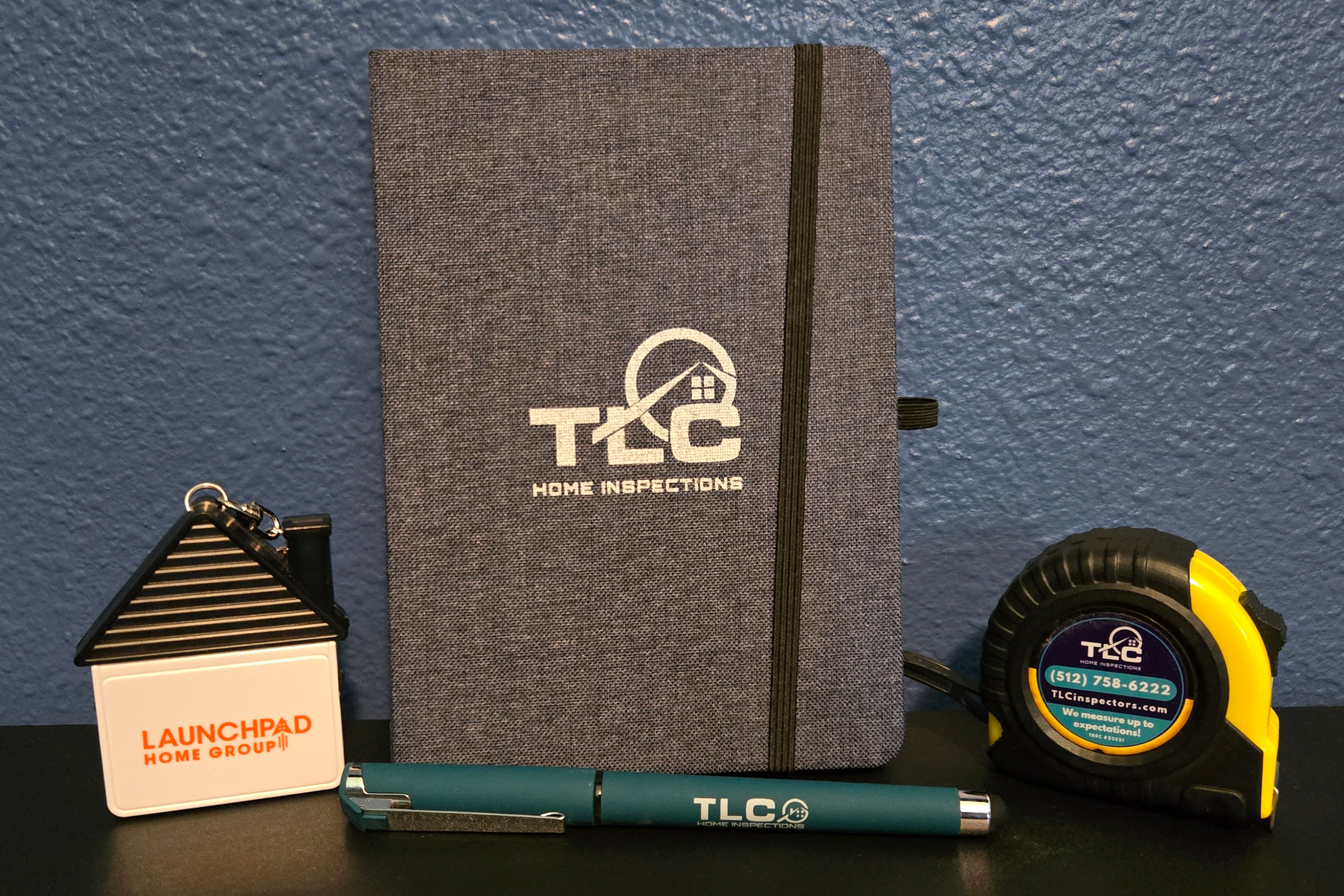
A somewhat frequent request, sales reps liked to have small swag items that kept our brands top of mind with potential clients while including a QR code, phone number, or website for them to reach us with. With home inspections needing long-tail marketing, the key to these swag items is that they had to be useful to the client, so that they would actually keep them around. Some examples (pictured below) include a measuring tape, a keychain mini tool kit, and a notebook/pen combo. The notebook included a sticker on the inside cover, so that we could provide a dynamic QR code as a CTA.